Water Damage Restoration in Thornton, CO
Thornton started in 1953 as Sam Hoffman's planned subdivision off Washington Street and incorporated on June 12, 1956, with a few thousand people in brick ranches near 88th Avenue. It passed 42,000 people by 1980, 82,000 by 2000, and 141,000 by 2020, and each of those waves left its own housing: shallow-basement ranches on the south end, split-levels and bi-levels through the middle of the city, and full-basement two-stories and slab houses north of 120th Avenue. All of it sits at about 5,210 feet on the clay plain between the South Platte River and the Front Range.
Water reaches a Thornton house from three directions. Summer thunderstorms fill window wells and push groundwater through the cove joint, hail bruises the roof and the leak shows up weeks later, and arctic fronts split the supply line in the garage wall.
This site connects Thornton homeowners by phone with an independent local water damage provider. The provider meters the house and writes the scope from the readings.
Thornton water damage by the season it arrives in
A basement that took groundwater through a foundation crack in a July storm is a basement flooding cleanup. A garage wall line that split during a December arctic night is a frozen pipe cleanup. A ceiling stain that appeared three weeks after the May hail is roof leak and hail water damage, and once the wet material is out, structural drying runs against daily readings.
Thornton's own permit desk and fire crews
Rebuild work that touches plumbing, wiring, or framing goes through the City of Thornton, and the city's own Thornton Fire Department runs eight stations across the city, so a burst pipe that trips a breaker or floods a furnace room gets a quick response. The lake at Carpenter Park on 112th Avenue is part of the same drainage the neighborhoods around it feed, and when it rises after a storm the basements uphill of it are usually already wet.
Call (720) 735-3725 and say which level of the house is wet. An independent local water damage provider serving Thornton picks it up from there.
Services Available in Thornton
Basement Flooding Cleanup
Water pumped out of a finished or unfinished Thornton basement, then the bottom of every wall and the slab metered to see what stayed wet.
Water Extraction
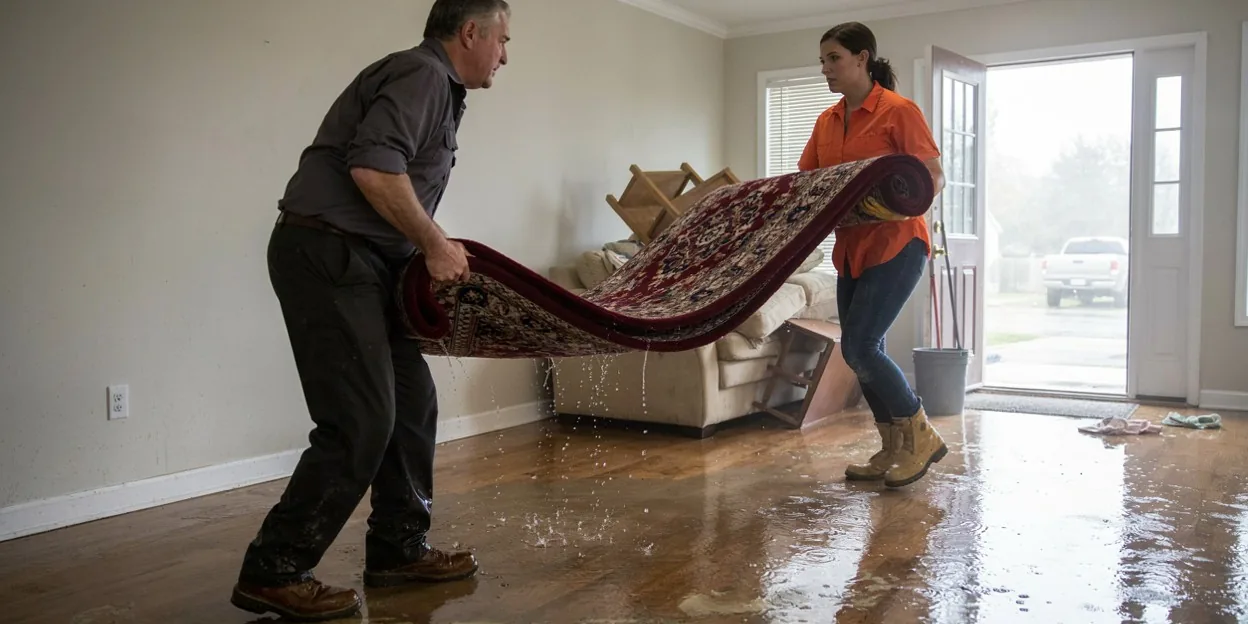
Standing water pulled off carpet, tile, wood, and concrete on any floor of the house, with the first moisture readings taken the same visit.
Structural Drying
Air movers and dehumidifiers set from daily readings until subfloor, studs, and drywall reach their dry target in a dry-climate house.
Frozen Pipe Cleanup
Cleanup after a supply line froze in a garage wall, crawl space, or north-facing wall during an arctic night and split when it thawed.
Burst Pipe Water Damage
A failed supply line, a cracked fitting, or an old galvanized run in a 1950s ranch let go, and the rooms it soaked get pumped out and dried.
Water Heater Leak Cleanup
The tank in the basement utility corner rusted through overnight, and the floor, framing, and stored boxes it soaked get dried out.
Roof Leak and Hail Water Damage
Wet attic insulation, ceilings, and walls dried after a hailstorm, a wind-torn shingle, or an ice dam let meltwater into the house.
Leak Detection
A high Thornton Water bill, a warm patch on a slab floor, or a damp spot with no visible source tracked to the pipe behind it before walls open.